October 06, 2026
Degenerative Disc Disease in the Low Back | Fayetteville, AR

Lumbar Degenerative Disc Disease: What It Really Means and How to Stay Ahead of It
You open your patient portal, and there it is: "multilevel lumbar degenerative disc disease." Your stomach drops. Disease? Degenerative? It sounds like a one-way street.
Here is what we tell patients at Wellness Professionals every week: that phrase describes what your spine looks like on a picture. It does not describe your future. Discs wear down a lot like tires do. How fast they wear depends on your genes, how well your spine moves, and how well you take care of it.
In this guide we explain, in plain English, what your doctor means by degenerative disc disease, why we see it differently here in Fayetteville, what the research says about slowing it down, and how our team helps you keep moving and stay ahead of it.
**What Doctors Mean by "Degenerative Disc Disease"
** Degenerative disc disease, or DDD, is the name doctors give to spinal discs that have dried out, thinned, and lost some of their cushioning over time. Between each pair of spine bones sits a disc. Picture a jelly donut: a tough, layered outer ring holding a soft, water-rich center. That design lets your spine bend, twist, and absorb shock all day long. As the years pass, the center slowly loses water, the disc flattens, and the outer ring can develop tiny cracks. The bones and small joints around the disc then take on extra load, and the body may add small bone spurs for support. In the low back (the lumbar spine), the bottom two levels, called L4-L5 and L5-S1, carry the most weight and do the most moving. That is why they are the most common places we see wear.
If you have an MRI or X-ray report, you may see words like these:
What the report says vs What it means in plain English
Disc desiccation The disc has lost water, like a sponge that has dried out
Disc height loss The disc has gotten thinner, so there is less cushion between the bones
Disc bulge
The disc's outer edge has spread past its usual boundary, like a tire bulging at the sidewall
Annular fissure or tear A small crack in the disc's tough outer ring
Osteophytes Bone spurs, the body's way of adding support where there is extra stress
Facet arthropathy
Wear in the small joints at the back of the spine
On your chart, the official wording is "other intervertebral disc degeneration, lumbar region" (ICD-10-CM category M51.36). Notice that it describes what happened to the disc: a degeneration. The word "disease" is the nickname that stuck.
Doctors use the label DDD whether or not the discs hurt. A scan can show wear in a person with no back pain at all, and that surprises most people. We will get to that shortly.
**
Our View: Wear and Tear, Not a Disease
**
At Wellness Professionals, we see degenerative disc disease as a wear-and-tear process, not a disease in the way most people picture one. "Disease" suggests something that invades the body or breaks down on its own, like an infection. Discs aging is closer to tread wearing down on a tire, or hair turning gray.
The research supports that. A systematic review of 33 studies covering 3,110 people with no back pain found disc degeneration on imaging in 37% of 20-year-olds and 96% of 80-year-olds. The authors concluded that many of these findings are likely part of normal aging and unrelated to pain. A review by physical therapy researchers goes further and argues that the word "disease" should be avoided for the same reason. **
So why do some discs wear faster? **
Genetics play a real part. Twin studies suggest family traits explain roughly 40 to 60 percent of the differences in disc wear, and that body weight and strength mattered more than a person's job or sports history. But genes load the dice. They do not roll them. The part we can work with is mechanics.
Think of a car with bad alignment. One edge of the tire wears out early, even though the tire itself is fine. In our clinical experience, the spine does the same thing. When a joint stops moving well, or the hips and core are tight or weak, one level of the low back ends up taking more than its share of every step, bend, and lift. Over the years, that disc wears faster.
Spine researchers describe disc degeneration as a breakdown in the disc's mechanical integrity, and the classic three-stage model of spinal degeneration begins with simple "dysfunction," well before any lasting damage shows up on a scan.
"Not a disease" does not mean "not a big deal." Worn discs can become more irritable and less stable, and the same review stresses that these changes have real clinical meaning. That is exactly why we believe the early stage is the best time to act.
**
The Phases of Disc Wear
**
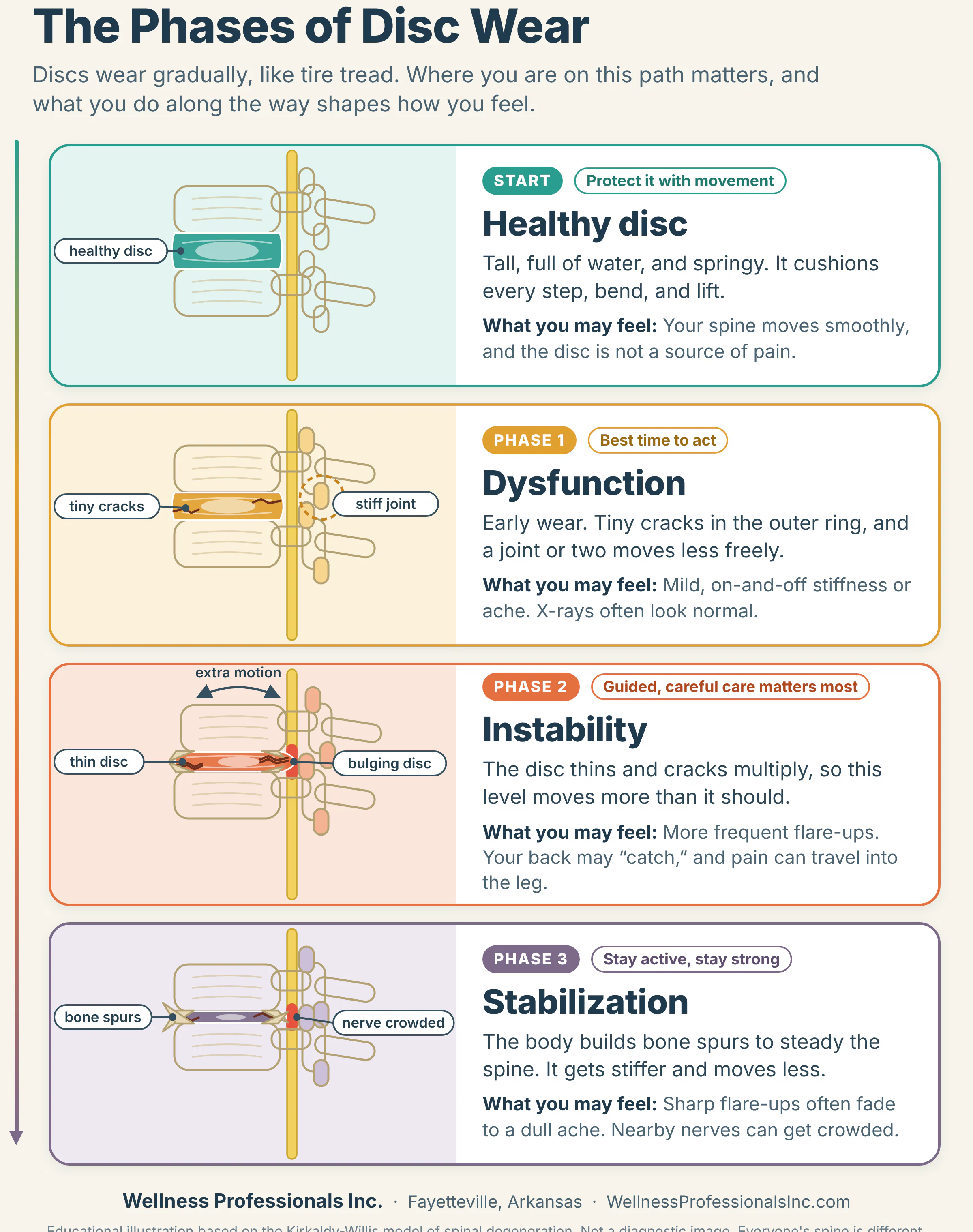
Spine researchers describe disc wear as a three-phase journey, known as the Kirkaldy-Willis model. The picture below shows a healthy disc and how each phase changes it. People move through the phases at very different speeds, and some never feel much at all.
-
Phase 1, Dysfunction. This is early wear and tear. The outer ring of the disc may develop small cracks, and a joint or two stops moving as freely as it should. Symptoms are usually mild and come and go: stiffness after sitting, soreness after activity, a low back ache that stays in the back. X-rays often look normal or nearly normal.
-
Phase 2, Instability. The disc loses height and the cracks multiply, so that level of the spine moves more than it should. Flare-ups become more frequent and stronger, and some people feel their back "catch" or "give way." Pain can travel into the leg. The body starts adding bone spurs and thickening ligaments to steady things.
-
Phase 3, Stabilization. The spine builds more bone and scar tissue to steady itself and becomes stiffer. Sharp flare-ups often settle into a dull, achy stiffness. In some people the extra bone narrows the space around nearby nerves, which can bring leg symptoms.
A scan alone cannot tell you which phase you are in. Your symptoms, how you move, and a hands-on exam tell the real story. In our view, Phase 1 is the best window to protect your discs, and Phase 2 is when guided, careful care matters most. Sources: Kirkaldy-Willis model overview and The Lumbar Degenerative Disc.
**
Why Your Scan and Your Pain Do Not Always Match
**
A scan shows what your discs look like. It cannot show how much they hurt. In the same review of people with no back pain, a disc bulge showed up in 30% of 20-year-olds and 84% of 80-year-olds, and disc degeneration climbed with every decade of life.
Two people can have identical MRIs. One trains for a half marathon. The other struggles to tie their shoes. The picture is the same, but the people are not.
Pain depends on much more than the disc itself: irritated joints, tight or weak muscles, a disc that is inflamed right now, stress, sleep, and how much you have been moving. That is why we treat the person, not the picture. At Wellness Professionals, your exam looks at how you move, where you are stiff, where you are unstable, and what you do all day, and then we build the plan around that.
**
Being Proactive: What the Research Says
**
We are not aware of any proven treatment that turns back the clock on a worn disc. What the research does show is that staying active, strong, and moving well lowers your odds of back pain episodes, and that is what you feel day to day.
**
Habits and What the research found
**
Exercise plus education A review of 21 trials with 30,850 people found that exercise combined with education cut the chance of a back pain episode by about 45% (moderate-quality evidence). Exercise alone cut it by about 35% (lower-quality evidence).
A regular walking habit In the WalkBack trial, published in The Lancet in 2024, 701 adults who had recently recovered from back pain were coached through a progressive walking program. They went a median of 208 days before their next flare-up, compared with 112 days for the comparison group.
A strong body at a healthy weight
The Twin Spine Study found that body weight and strength were more closely linked to disc wear than a person's job or sports history, though all effects were modest. The authors also suggested that routine physical loading may help discs adapt, much as muscles and bones do.
Back belts, shoe insoles, and handouts alone
None of these reduced back pain episodes in the same 21-trial review.
One honest caution: these studies measured back pain, not disc images. Following discs on MRI for years is much harder to study. We believe that keeping your spine moving, strong, and well aligned also protects your discs, because it spreads the load more evenly. That is our clinical reasoning, and it fits the research above, but it is not yet a proven fact.
**
Our proactive playbook
**
• Walk most days. The WalkBack goal was about 30 minutes, five days a week, built up gradually.
• Strengthen your core, hips, and back. Strong muscles share the work so your discs do not carry it all.
• Keep your joints moving. In our view, stiff or poorly moving spots in the spine and hips are the "bad alignment" that can make one disc wear faster than the rest.
• Break up long sitting. Stand, stretch, and walk for a minute or two every half hour or so.
• Get checked early. Do not wait for Phase 2. Small problems are easier to fix than big ones.
**
How Chiropractic Care Helps
**
Spinal manipulation, the hands-on core of chiropractic care, is one of the drug-free options a major medical guideline recommends first for low back pain. The American College of Physicians guideline lists spinal manipulation, massage, and heat as first-line choices for recent back pain, and spinal manipulation alongside exercise for long-lasting back pain. It says opioids should be a last option.
The evidence behind that advice is solid. A 2019 BMJ review pooled 47 trials with 9,211 people who had chronic low back pain. Spinal manipulation worked about as well as other recommended treatments, and it relieved pain and improved function better than treatments that are not recommended. Side effects were mostly mild, short-lived soreness.
It may also help you avoid stronger medication. In a study of 216,504 adults with new low back pain, people who saw a chiropractor first had about 90% lower odds of filling an opioid prescription within 30 days than people who saw a primary care doctor first. That study was observational, so it shows a strong link and not proof of cause.
**
What care looks like with us
**
We are clear about what we do not claim: no adjustment regrows a disc. What good chiropractic care can do is calm pain, restore motion to stiff joints, and teach you how to protect your back, so that worn discs are not asked to do more than their share.
• A careful exam. We look at how you move, where you are stiff, where you are overworking, and what your scan means for you.
• Hands-on care matched to your phase. Techniques are chosen to fit your spine, with gentler, lower-force options where they make sense. Some spine researchers caution against forceful rotation in unstable degenerated segments, so care is never one-size-fits-all.
• Movement coaching. Exercise and education are the pieces the prevention research rewards most, so they are part of the plan from day one.
• A plan you can see. You know the goal, how we will measure progress, and when you can step down your visits.
**
Everything Under One Roof
**
Disc wear is rarely fixed by one tool, so we put the whole toolbox in one building in Fayetteville. Here is how each piece fits.
**
Service and How it helps with disc wear and low back pain
**
Chiropractic care
Restores motion to stiff joints, calms pain, and teaches you how to protect your back. Spinal manipulation is a first-line, drug-free option in the American College of Physicians guideline.
Physical therapy Spine & Sports Physical Therapy, in the same office, builds the strength and control that take load off your discs. Exercise is the most consistent winner in the prevention research above.
DAVID spine therapy Machine-based, measured strengthening for the muscles that support your spine. A 2025 review of 8 small randomized studies (381 people) found that a similar kind of machine-based lumbar strengthening reduced pain. The evidence is early, so we call it promising, not proven.
Spinal decompression
Gentle, traction-style care, paired with an exercise plan. Spine researchers have supported hands-on traction combined with stabilization exercise for degenerating discs.
Pilates reformer classes
55-minute classes that build core control, flexibility, and good movement habits. A Cochrane-based review found Pilates beat minimal care for back pain and disability, but not other exercise. The best exercise is the one you enjoy enough to keep doing.
Massage therapy Eases tight muscles that tend to guard a sore back. Massage is also a first-line option for recent back pain in the same guideline.
Because it is all under one roof, your providers can compare notes and keep your plan simple. Our goal is to make you independent: a solid home exercise program, clear milestones, no long treatment plans, and no gimmicks.
**
When to Get Checked Right Away
**
Most back pain is not an emergency, but a few signs are. Go to the emergency room, not a clinic, if you have:
• New trouble controlling your bladder or bowels
• Numbness in the groin, genitals, or inner thighs
• Leg weakness that is getting worse, or a leg that suddenly gives out
• Back pain with fever, chills, or unexplained weight loss
• Severe back pain after a fall, car accident, or other serious injury
Come see us soon if your pain has lasted more than a few weeks, travels down a leg, comes with numbness or tingling, or keeps coming back. These are signs your spine needs a closer look, and early care is easier than late care.
Ready to find out which phase your spine is in? Book an exam with Dr. Michael Dickerson and the team at Wellness Professionals Inc. in Fayetteville, Arkansas, at WellnessProfessionalsInc.com. This article is for education and is not a substitute for personal medical advice. Every spine is different, so your exam comes first.
**
Frequently Asked Questions
**
What is lumbar degenerative disc disease?
Lumbar degenerative disc disease (DDD) is the label doctors use when the cushioning discs in the low back have lost water and height over time. It is common, it often shows up on MRI reports, and it does not always cause pain.
Is degenerative disc disease really a disease?
At Wellness Professionals, we view it as a wear-and-tear process, not a disease in the traditional sense. A review of 33 studies found disc degeneration on imaging in 37% of pain-free 20-year-olds and 96% of pain-free 80-year-olds.
Can chiropractic care help degenerative disc disease?
Chiropractic care can help the pain and stiffness that often come with disc wear. Spinal manipulation is a first-line, drug-free option in the American College of Physicians guideline, and a 2019 BMJ review found it worked about as well as other recommended treatments for chronic low back pain. It does not regrow a disc.
Can degenerative disc disease be reversed?
We are not aware of a proven way to reverse disc wear. The good news is that exercise, walking, a healthy weight, and good movement lower your chances of back pain episodes, and that is what most people want to change.
What is the best exercise for degenerative disc disease?
The best plan is one built for your spine and one you will actually do. Research supports exercise combined with education, a regular walking habit, and core and hip strengthening, which is why we build a home exercise plan for every patient.
Is it safe to see a chiropractor if I have degenerative disc disease?
For most people, yes, when care is matched to the individual. Bring your imaging and tell us about your symptoms, because we choose techniques that fit your spine. Side effects in the research were mostly mild, short-lived soreness.
Does degenerative disc disease always cause pain?
No. Many people with disc wear on a scan have no pain at all, and many people with back pain have scans that look surprisingly mild. That is why your symptoms and exam matter as much as the picture.
When should I worry about back pain?
Go to the emergency room for new bladder or bowel problems, numbness in the groin or inner thighs, worsening leg weakness, back pain with fever or weight loss, or back pain after a serious injury. For anything else that lasts more than a few weeks, come see us.
Sources and Further Reading
Every source below was opened and read for this article. The one exception is the full text of the WalkBack paper in The Lancet, which was read through the two summaries linked here. Everything is linked so readers can check the details.
- Brinjikji et al., AJNR, 2015: Systematic literature review of imaging features of spinal degeneration in asymptomatic populations (33 studies, 3,110 people)
- The degenerative lumbar disc: not a disease, but still an important consideration (history and science of discogenic instability)
- The Foundation of a New Paradigm of Disc Degeneration: The Twin Spine Study
- Steffens et al., JAMA Internal Medicine, 2016: Prevention of Low Back Pain: A Systematic Review and Meta-analysis
- WalkBack trial, The Lancet, 2024: summary in The Conversation and ACE Fitness review
- Rubinstein et al., BMJ, 2019: Benefits and harms of spinal manipulative therapy for chronic low back pain (47 trials, 9,211 people)
- American College of Physicians: Guideline for treating nonradicular low back pain
- Kazis et al., BMJ Open, 2019: Initial healthcare provider for new-onset low back pain and opioid use (216,504 adults, observational)
- Scientific Reports, 2025: Isolated lumbar extension strength training for low back pain, systematic review and meta-analysis (8 studies, 381 people, very low certainty)
- Pilates for low back pain (Cochrane-based review)
- Phases of disc wear: Kirkaldy-Willis model overview and The Lumbar Degenerative Disc
- The DAVID Spine Concept (manufacturer information, used only to describe the equipment)
- ICD-10-CM category M51.36, "Other intervertebral disc degeneration, lumbar region" (current code set, checked October 2026)


Dr. Michael Dickerson
Dr. Michael Dickerson is a graduate of Parker College of Chiropractic. Upon Graduation, Dr. Dickerson practiced in Bastrop, LA before returning home to Northwest Arkansas. Dr. Dickerson has always focused on obtaining the best result for his patients and staying current on the best neuro spinal biomechanical treatments in the profession.